
Speed vs. Context: The Dilemma in Modern Threat Intelligence
25.11.2025 | Authors: Markus Ludwig | Categorized as: Threat Intelligence, Cybersecurity, Enrichment, Context
In the fast-paced world of cybersecurity, organizations face a critical dilemma: Should you act immediately on early-stage Indicators of Compromise (IOCs), or wait for full context before taking action? This question lies at the heart of effective Cyber Threat Intelligence (CTI). The wrong choice can mean the difference between stopping a breach in its tracks or suffering a devastating attack.
The Competing Philosophies
1. Wait for Context
Many security teams prefer to wait until IOCs are fully attributed to a malware family or threat actor. The logic is simple: higher confidence leads to more reliable detection. However, this approach comes with a significant risk—hours or even days of exposure while waiting for enrichment. In the case of zero-day ransomware, the first 24-48 hours are often the most critical. Delaying action can allow threats to spread, expanding the blast radius and increasing potential damage.
2. Act on First Sighting
On the other hand, deploying IOCs immediately upon discovery ensures faster protection against emerging threats. But this speed comes at a cost: potential false positives and unclear severity. Without context, security teams may waste valuable time chasing low-severity alerts, leading to alert fatigue and reduced overall effectiveness.
The Cost of Waiting
- Zero-day ransomware spreads rapidly in the first 24-48 hours.
- Initial IOCs often appear 6-44 hours before attribution is confirmed.
- Delayed deployment means expanded exposure—giving attackers more time to infiltrate systems.
Yet, acting too quickly without context can flood Security Operations Centers (SOCs) with noise. Research shows that 60-80% of false positives can be reduced with proper enrichment, but the window for initial protection is narrow.
The Challenge of Labels and Data Overload
The sheer volume of IOCs is overwhelming:
- 877 million+ distinct IOCs from over 1,100 sources.
- Only 712,000 are assigned meaningful labels (e.g., family names, MITRE techniques, or actor associations).
- Most IOCs remain unclassified for hours or even days.
For example, hashes take an average of 18.3 hours to be labeled, while some domains can remain unlabeled for up to 592 hours. This delay leaves organizations vulnerable.
Statistics of label progress over 30 days
| Type | New IoCs | % without threat labels | % with threat labels | % labeled immediately | % labeled Later | Average hrs until labeled | Max hrs until labeled |
|---|---|---|---|---|---|---|---|
| DOMAIN | 5,646,708 | 65.36 | 34.64 | 12.91 | 21.73 | 22.6 | 592.1 |
| 102,386 | 99.95 | 0.05 | 0.03 | 0.01 | 6.8 | 23.1 | |
| HASH | 3,319,405 | 89 | 11 | 9.53 | 1.47 | 18.3 | 1817.3 |
| IP | 4,076,299 | 89.64 | 10.36 | 8.33 | 2.03 | 44.9 | 714.9 |
| URL | 2,155,380 | 98.09 | 1.91 | 1.73 | 0.18 | 32.4 | 668.0 |
Finding the Middle Ground
A balanced approach is essential. Here’s how to strike the right balance:
1. Tiered Response Based on Confidence
- Low Confidence: Log and monitor.
- Medium Confidence: Alert and investigate.
- High Confidence: Block immediately.
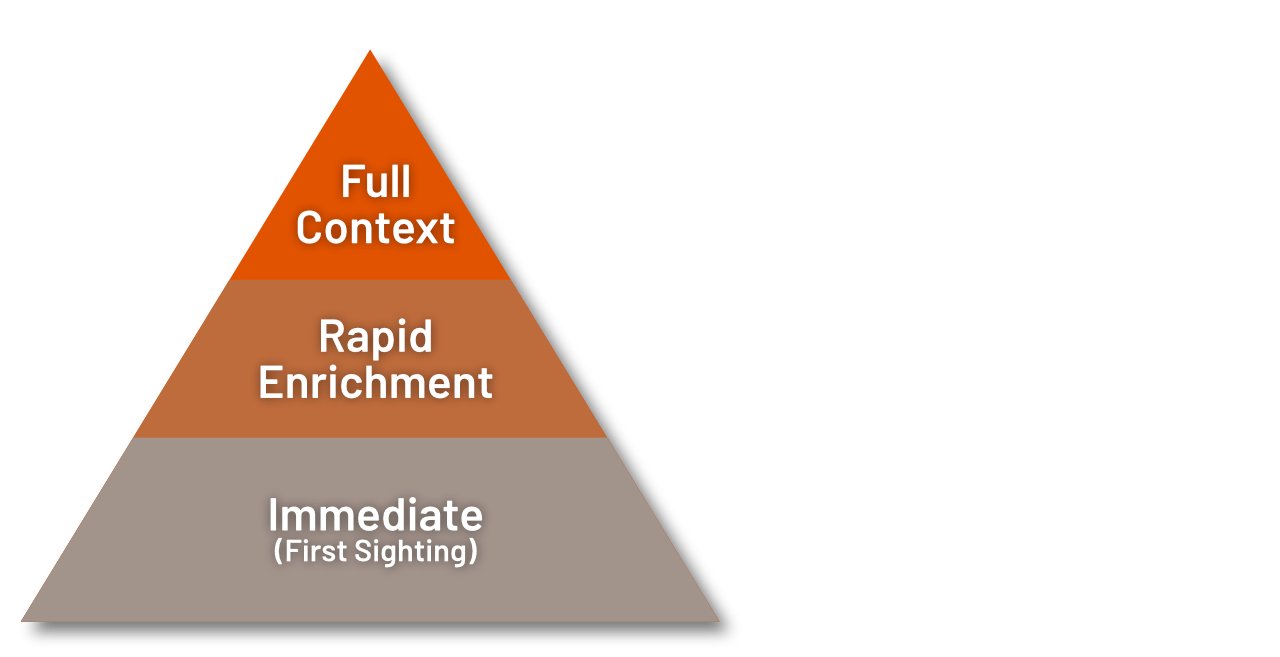
2. Progressive Enrichment
- Ingest IOCs immediately in a "monitoring" state.
- Auto-upgrade confidence as more context becomes available.
- Escalate responses based on predefined thresholds.
3. Measure What Matters
Track key metrics:
- Time-to-first-protection (speed).
- False positive rate (accuracy).
- Noise reduction (eliminating meaningless labels).
Maximizing Intelligence with CTI Source Combination
Not all IOCs are created equal. Some are well-documented with family names, MITRE techniques, and actor associations, while others remain vague. By combining multiple CTI sources, organizations can maximize their intelligence and make more informed decisions.
Conclusion: Speed AND Context Are Possible
The key is not to choose between speed and context, but to integrate both. Deploy early, enrich continuously, and escalate progressively. This way, you can protect your organization without drowning in false positives.